How TTN Check Helps Students with Turnitin AI Detection and Plagiarism Checking
Introduction
Preparing an academic paper for submission involves more than completing the assignment. Students must also ensure that their work follows academic integrity guidelines, uses appropriate citations, and complies with their institution's policies on AI-assisted writing.
TTN Check can help students review their documents by providing access to Turnitin-related AI detection and similarity checking services. These checks can help students understand potential text-matching issues and review AI detection results before submitting their assignments.
Whether you are working on an essay, dissertation, research paper, coursework, or thesis, understanding your report can help you make informed decisions about your writing.
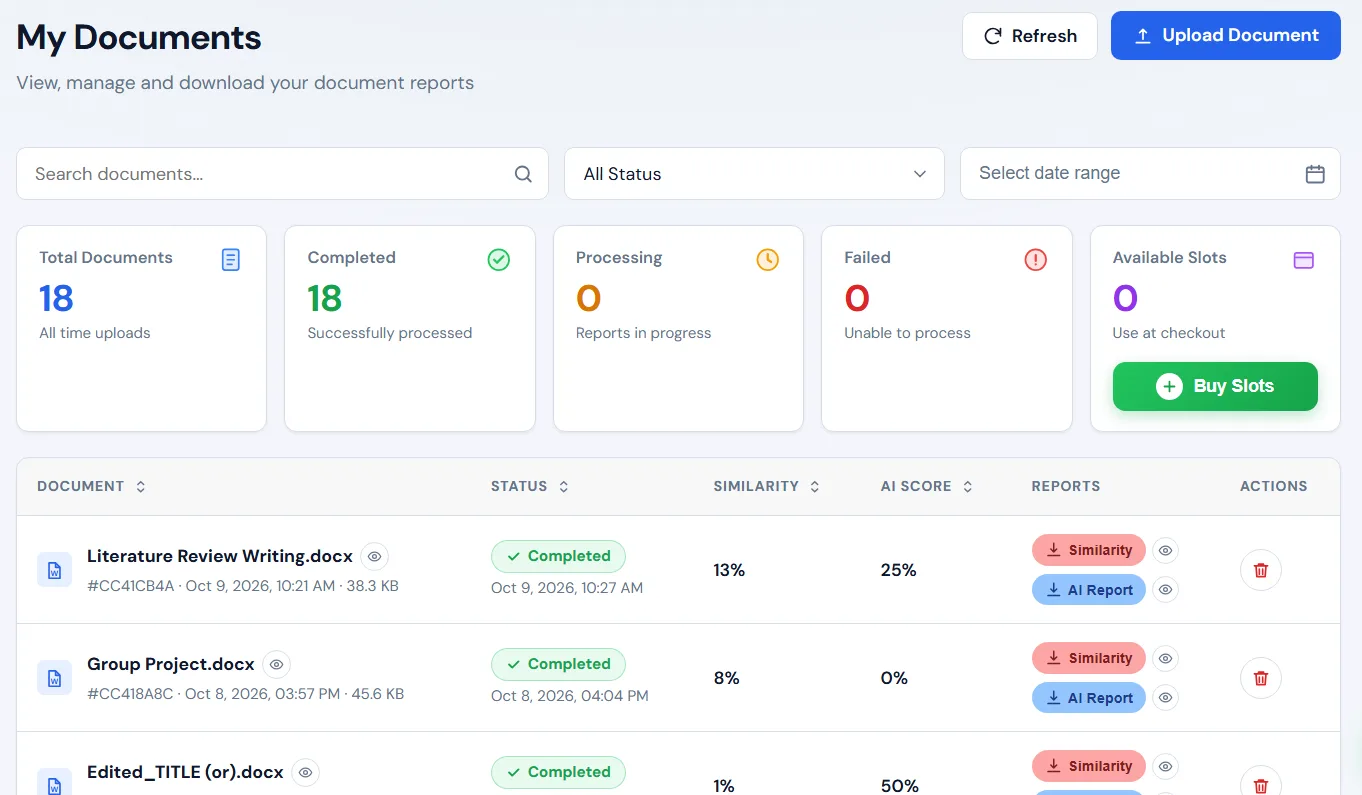
What Is TTN Check?
TTN Check is a document-checking option available through aiandplagiarismcheck.com. It is intended to help students review their academic documents using AI detection and text similarity checking services.
Students can use document-checking services to examine their work, identify passages that may require attention, and better understand the results before submitting their assignments.
The two main areas students may want to investigate are:
Plagiarism and similarity checking: Identifies text that matches material in comparison databases, helping students review potential citation and originality concerns.
AI writing detection: Provides an indication of whether qualifying text may have been generated or modified using AI writing tools, depending on the detection service used.
These checks serve different purposes. Reviewing both can provide a broader understanding of potential issues in an academic document.
How TTN Check Helps with Turnitin Plagiarism Checking
Similarity checking is useful because academic assignments often contain ideas, quotations, definitions, and information drawn from existing sources. Students must acknowledge those sources appropriately.
TTN Check can assist students by making it easier to review similarity results and identify passages that may need further attention.
1. Identifying Matching Text
A similarity report highlights passages that match material in the databases used for the check. By reviewing these matches, students can identify wording that may have been reproduced from another source.
A match does not automatically mean plagiarism has occurred. Correctly cited quotations, reference lists, standard expressions, and commonly used terminology may also generate matches.
2. Reviewing Citation and Referencing Issues
A report can help students identify passages that deserve closer examination to determine whether citations are missing, incomplete, or incorrectly placed.
Students should check that borrowed ideas are properly acknowledged and that quotations and paraphrases comply with their required referencing style, such as APA, Harvard, or MLA.
3. Improving Academic Writing
Reviewing matching passages can help students identify opportunities to improve their paraphrasing and express ideas more clearly in their own words.
However, paraphrasing should not be used to conceal copied work. Students must still acknowledge the original source whenever they use another author's ideas.
4. Understanding Similarity Results
A similarity percentage provides only a numerical overview of matching text. It does not independently determine whether a paper has breached academic integrity rules.
TTN Check can help students review the available results, but students should interpret the report carefully and follow their institution's requirements.
How TTN Check Helps with Turnitin AI Detection
AI writing detection has become an important consideration for students as universities establish policies governing the use of tools such as ChatGPT and other AI writing assistants.
Where an AI detection report is available, students can use it to understand how their submitted text has been assessed by the relevant detection system.
1. Reviewing AI Detection Results
AI detection tools estimate whether certain text may have been generated or modified using AI writing tools. Reviewing the results can help students identify passages they may wish to examine more closely.
An AI detection result is not definitive proof that a student used AI. Detection systems can produce false positives and false negatives, so their results must be interpreted cautiously.
2. Understanding the Difference Between AI and Similarity Reports
An AI writing report and a similarity report measure different things.
The similarity report identifies text matching existing sources, while an AI detection report estimates the likelihood that qualifying text was generated or modified using AI.
Consequently, a document may have a low similarity score but still receive an AI writing indicator. The reverse is also possible.
By reviewing both reports, students can better understand the different aspects of their document that may require attention.
3. Supporting Responsible AI Use
Students should always follow their institution's policies on AI-assisted writing. Depending on those rules, permitted uses may include brainstorming, language assistance, or other forms of support, while some uses may be restricted or require disclosure.
TTN Check can support the document-review process, but it cannot determine whether a student's use of AI complies with a particular university's rules. Students remain responsible for ensuring that their work meets the applicable requirements.
How to Use TTN Check Before Submitting an Assignment
Students can follow a straightforward process when checking their academic documents.
Step 1: Prepare your document.
Complete your assignment and ensure that its citations, references, and formatting are in place.
Step 2: Visit aiandplagiarismcheck.com.
Explore the available checking services and confirm which reports are included in the option you choose.
Step 3: Submit your document according to the website's instructions.
Follow the upload and payment instructions, where applicable. Check the service description and terms before proceeding.
Step 4: Review your reports.
Examine the similarity report for matching passages and citation concerns. If an AI detection report is provided, review its findings separately.
Step 5: Make appropriate corrections.
Correct missing citations, improve unclear paraphrasing, and address any other issues you identify. Do not change legitimate writing simply to manipulate an AI detection score.
Step 6: Check your institution's requirements.
Before submitting your final paper, verify that it complies with your university's academic integrity and AI-use policies.
Why Students Should Check Their Documents Before Submission
Checking a document before submission can offer several practical benefits.
Greater awareness: Students can understand potential similarity and AI detection concerns before submitting their work.
Better referencing: Reviewing matching passages can help identify possible citation errors.
More informed revisions: Reports can guide students towards passages that deserve further investigation.
Improved preparation: Students can check whether their work is ready for submission under their institution's requirements.
Convenience: Online document-checking services can provide an accessible option for students who want to review their work independently.
However, no checking service can guarantee that an institution will accept a paper or that its assessment system will produce identical results. Report availability and results may vary depending on the checking method, databases, settings, and institutional configuration.
TTN Check vs. Checking Only the Similarity Percentage
One common mistake is to judge a paper entirely by its similarity score. A low percentage does not guarantee correct referencing, and a high percentage does not automatically indicate plagiarism.
Similarly, an AI detection indicator should not be treated as a verdict on a student's writing process.
The most effective approach is to examine the actual report, investigate the relevant passages, and make revisions based on sound academic principles.
Students should also confirm whether the service they purchase provides an actual Turnitin-generated report or a report from another provider. The name of a checking service alone does not establish which detection system is used.
Frequently Asked Questions
Does TTN Check guarantee a zero similarity score?
No. Similarity scores depend on the document, comparison databases, and checking settings. The goal should be correct referencing and academic integrity rather than achieving a particular percentage.
Can TTN Check guarantee that Turnitin will not flag my paper for AI?
No. AI detection systems can produce different results, and no independent checking service can guarantee a particular outcome from a university's system.
Is a high AI detection score proof of cheating?
No. An AI detection score is an estimate, not conclusive proof of misconduct. Students should follow their institution's procedures and provide appropriate evidence of their writing process if a result is questioned.
Should I check both AI detection and similarity?
Where both services are available and relevant to your institution's requirements, checking both can help you examine different aspects of your document. They should be interpreted separately.
Where can I access TTN Check?
Visit aiandplagiarismcheck.com to explore the available document-checking options and confirm which reports are offered.
Conclusion
TTN Check can help students take a more informed approach to reviewing their academic work by providing access to document-checking services focused on similarity and AI detection.
By examining reports carefully, checking citations, improving paraphrasing, and following institutional guidelines, students can prepare their assignments more responsibly before submission.
Neither an AI detection score nor a similarity percentage should be treated as a definitive judgment of academic integrity. The value of checking lies in understanding the results and using them to support accurate referencing, responsible writing, and compliance with academic requirements.
Ready to review your document? Visit aiandplagiarismcheck.com to explore the available checking services and choose the option that meets your needs.