Turnitin AI and Plagiarism Checker in Australia: What Students Need to Know
Turnitin AI and Plagiarism Checker in Australia: A Student's Guide to AI and Similarity Reports
You have finished your assignment, checked the references and read it one last time. Then a new question pops up: what will Turnitin say about it? If you study in Australia, you might be wondering whether a similarity score is too high, whether your writing could be mistaken for AI, or how to see a report before submitting your work.
The useful thing to know is that Turnitin produces different kinds of information. A similarity percentage is not a plagiarism verdict, and an AI detection result is not proof of who wrote your paper. Understanding that difference makes both reports much less intimidating.
Two reports, two very different questions
Think of a Similarity Report as a way to locate text that resembles material already in Turnitin’s comparison sources. It can point you to passages that deserve a closer look, such as an uncited quotation or a sentence that follows a source too closely. But it cannot decide whether you have committed plagiarism.
An AI Writing Detection report asks a different question: does qualifying prose show patterns the system associates with AI-generated writing? Its assessment is probabilistic and can be wrong. A paper could have a low similarity score and an AI flag, or a higher similarity score and no AI text flagged. One percentage cannot explain the other.
What if your AI report shows an asterisk instead of a percentage?
Imagine opening your report and seeing “*% detected as AI”. It looks odd, especially if you expected a number. For the report format illustrated here, the asterisk is used when the estimated AI result is above 0% but below 20%. Turnitin suppresses the precise percentage in this range because false positives are a particular concern.
In other words, *% does not mean 20%, and it certainly does not establish misconduct. The low-range result is not presented as an exact score, and the report does not highlight specific passages for that result. If you wrote the work yourself, keep your outlines, notes and version history; those records are more useful than trying to rewrite sentences merely to change a detector result.
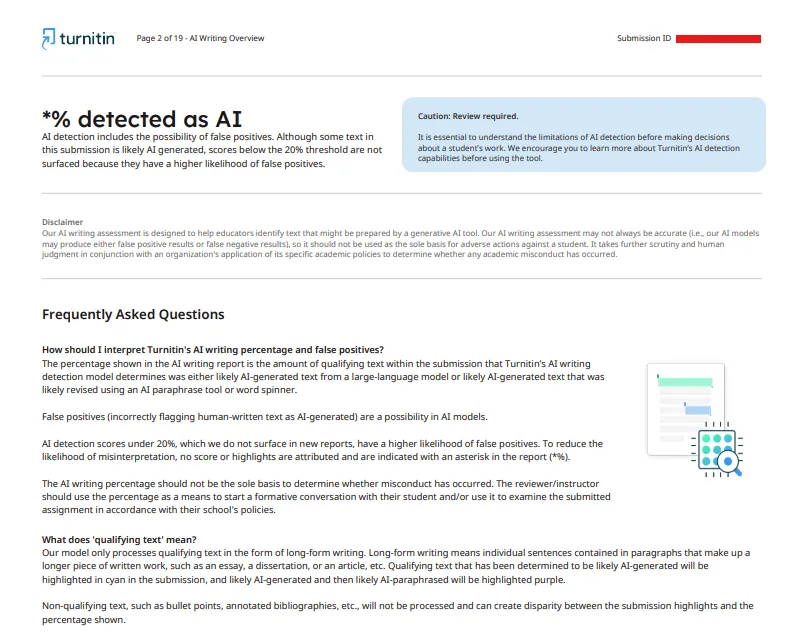
Example: An AI Writing Overview displaying *% rather than a numerical low-range result.
Does 0% AI mean your work is definitely human-written?
Not quite. A 0% result means that, in the text assessed, the detector did not identify qualifying prose as likely AI-generated. That may be reassuring, but it is not a certificate of human authorship. Likewise, a non-zero result is not automatic proof that a student used AI improperly.
Remember that the tool does not evaluate every type of content in exactly the same way. Long-form prose is its focus. If your assignment contains tables, formulas, lists or other material, do not assume that every word received the same assessment.
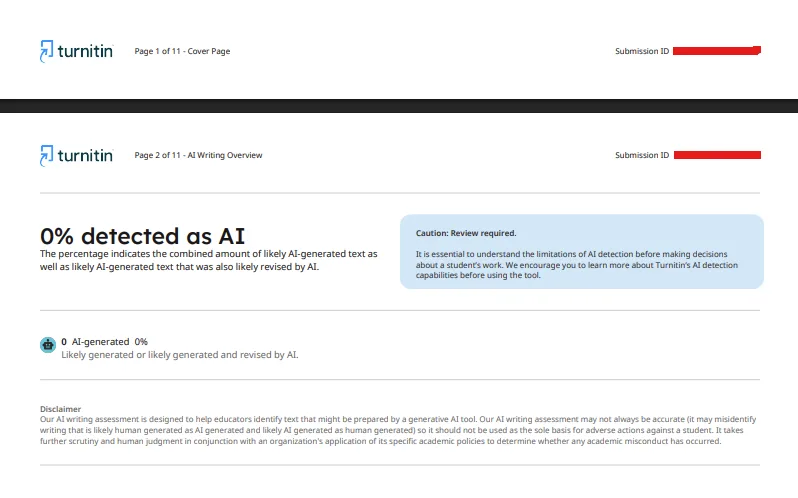
Example: a separate AI Writing Overview showing 0% detected as AI
An 8% similarity score: should you worry?
Suppose your Similarity Report shows 8%. You might be tempted to celebrate immediately. It is a relatively small amount of matching text, but the percentage alone does not tell you whether the matches are acceptable. One copied paragraph without attribution could matter more than several correctly quoted and referenced passages.
In the sample report accompanying the original article, overall similarity is 8%. Its source categories show 5% internet sources, 0% publications and 5% submitted student papers. Those categories can overlap, so you cannot simply add them together. The example also records 8% under “Not Cited or Quoted” and no integrity flags for review.
That report excluded the bibliography, quoted text and matches shorter than eight words. Such settings can change the displayed result. Your next step should be to open the matches, identify the source material and check whether quotations, paraphrases and citations are handled properly.
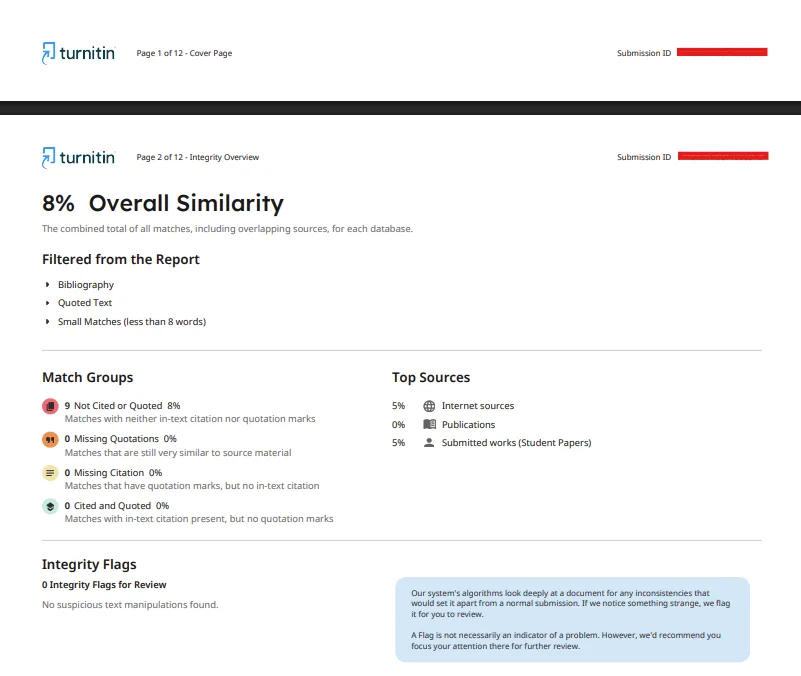
Example: a separate Similarity Report showing 8% overall similarity.
Is there an acceptable Turnitin percentage at Australian universities?
There is no single nationwide percentage that automatically makes an assignment acceptable. Universities, faculties and individual assessment tasks can apply different academic integrity expectations. A literature review, for example, may contain more source-related language than a personal reflection. What matters is how the matching text is used and acknowledged.
The same principle applies to AI. One lecturer may permit brainstorming with an AI tool if you disclose it; another assessment may restrict that use. Check your subject outline and assessment instructions instead of relying on a rule you saw on social media.
A sensible checklist before you submit
· Read your assignment instructions and your institution’s AI-use policy.
· Check every significant similarity match against the original source.
· Use quotation marks for direct wording and cite paraphrased ideas correctly.
· Keep drafts, research notes and document revision history.
· Ask your lecturer or tutor when a report or policy is unclear.
Can you get a report before submitting in Australia?
If your university gives you access to a draft-checking option, start there. You can also explore an independent report-request service at TTN Check, which offers requests for eligible Word and PDF documents without requiring your own institutional Turnitin login.
The process is straightforward: create an account, upload an eligible document, request the available checks and review the reports in your dashboard once processing is complete. Turnaround and eligibility can vary, so confirm the current terms and price before paying. An independent report may differ from a later university report because of settings, comparison databases, filters or document changes.
Questions students often ask
Can Turnitin falsely flag human writing as AI? Yes. False positives are possible, which is why a detection result should not be treated as the sole evidence of misconduct.
Will an external check replace my university submission? No. Your university’s official submission and academic integrity requirements still apply.
Use the report as a starting point, not a verdict
A Turnitin report is most valuable when it helps you ask better questions about your writing. Are your sources acknowledged? Have you quoted accurately? Do you understand the AI rules for your assessment? Those are the things you can actually act on. Read the detail behind the percentages, make genuine improvements and submit work you can explain and stand behind.
Note: TTN is an independent document-checking service.
Related Article: Turnitin AI and Plagiarism Checker in Switzerland: Get Reports with TTN