Turnitin AI Detection Explained: Understanding Your AI Score and How TTN Check Helps
Understanding Turnitin AI Detection
Artificial intelligence tools have changed how students research, plan, and write academic assignments. Although these tools can support learning, many universities have introduced policies governing their use in essays, dissertations, research papers, and other academic work. Consequently, understanding AI detection has become an important part of preparing academic documents.
Turnitin offers an AI writing detection feature designed to help educators identify text that may have been generated using artificial intelligence. When this feature is available and enabled, it provides an AI Writing Report that estimates the proportion of qualifying text likely to have been generated or modified using AI.
For students, understanding this report can help them interpret the results, identify passages that may require closer examination, and make informed decisions about their academic work. This is where TTN Check, available through aiandplagiarismcheck.com, can help students review their documents using the checking services offered by the platform.
How Does Turnitin AI Detection Work?
Turnitin's AI detection system analyses qualifying text and estimates whether it is likely to have been generated by an AI writing tool or generated and subsequently modified using AI. The results are presented in an AI Writing Report.
Unlike a traditional similarity report, which identifies text matching material in comparison databases, an AI Writing Report focuses on characteristics of writing that the detection model associates with AI-generated text.
The two reports therefore serve different purposes. A document may contain little matching text but still receive an AI writing indicator. Equally, a document may contain substantial text matches without receiving a high AI writing indicator.
It is important to understand that AI detection is an estimation rather than a definitive determination of how a document was written. Results should be considered alongside the student's writing process, the assignment requirements, and the institution's academic integrity policies.
Understanding a Turnitin AI Detection Report
A Turnitin AI Writing Report contains information that can help educators review potential AI-generated content. Students who obtain access to such a report should understand its key elements before interpreting the results.
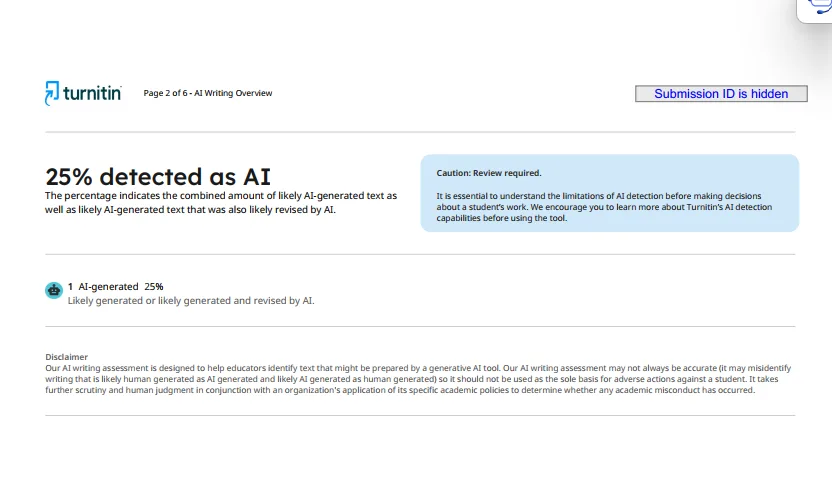
Example of a Turnitin AI Writing Overview showing a 25% AI detection indicator and a caution that the result requires review.
The uploaded sample contains several important elements:
1. The AI Detection Percentage
The report displays “25% detected as AI.” In this example, the figure represents the combined amount of qualifying text identified as likely AI-generated or likely AI-generated and subsequently revised using AI, according to the report's explanation.
This percentage should not be interpreted as proof that a student deliberately used AI or committed academic misconduct. It is an indicator generated by the detection system and requires appropriate interpretation.
2. The AI-Generated Text Indicator
The sample also displays “25% detected as AI”, accompanied by the explanation that the text is likely generated or likely generated and revised by AI.
This element helps communicate the classification of the text assessed by the system. However, the result does not independently establish who wrote the document, which tool may have been used, or whether any AI use violated institutional rules.
3. The Caution Message
The report displays “Caution: Review required.” This message is particularly important because it reinforces the need to examine AI detection results carefully.
An AI detection percentage should not be treated as an automatic judgment. Further scrutiny and human judgment are necessary when evaluating whether academic misconduct has occurred.
4. The Accuracy Disclaimer
The sample's disclaimer explains that Turnitin's AI assessment may incorrectly identify human-written text as AI-generated or AI-generated text as human-written. It also states that the assessment should not be used as the sole basis for adverse action against a student.
This limitation highlights why students should understand the report rather than focus exclusively on the percentage displayed.
Why Can Turnitin Flag Human-Written Text?
AI detection systems are not perfectly accurate. Human-written text can sometimes be classified as potentially AI-generated, while AI-generated text may not always be identified.
A detection result alone does not explain the circumstances in which the document was written. It cannot conclusively establish whether a student used an AI tool, how much assistance was involved, or whether the use was permitted.
Students who are concerned about an AI detection result should review their institution's policies and retain appropriate evidence of their writing process, such as drafts, notes, outlines, and version history where available.
They should also be prepared to explain their arguments, sources, and research methods if their institution requests clarification.
The responsible approach is to treat an AI report as information requiring interpretation, not as a final verdict on the originality or integrity of a student's work.
How TTN Check Helps Students Review Their Documents
TTN Check, through aiandplagiarismcheck.com, provides students with an option to explore document-checking services before submitting their academic work.
Where the relevant reports are offered, students can use the checking process to review AI detection results and text similarity findings. These checks can help them understand potential concerns and decide which parts of their documents need further examination.
TTN Check can assist students in several ways:
Understanding AI detection results: Reviewing an available AI report helps students understand the percentage displayed and the need to interpret it cautiously.
Examining text similarity: A similarity report can help identify passages matching existing sources, allowing students to check quotations, paraphrasing, and citations.
Identifying areas for review: Reports can direct attention towards passages that deserve further investigation. Students can then assess those passages in light of their writing process and academic requirements.
Supporting responsible preparation: Reviewing a document before submission can encourage students to check their referencing, confirm compliance with AI-use policies, and ensure that their work reflects their own understanding.
The reports do not guarantee a particular result from a university's checking system, nor can they guarantee that an institution will accept a document. Students should verify which detection tools and reports are included in the service before placing an order.
What Should You Do If Your Paper Receives an AI Detection Score?
If your report displays an AI writing indicator, avoid making assumptions based on the percentage alone.
Start by reviewing the available report and understanding what the result represents. Consider whether your institution permits the AI assistance used and whether disclosure is required.
Next, review your drafts, notes, and other available evidence of your writing process. If you believe the result is inaccurate, follow your institution's procedures for raising concerns and explaining how you developed your work.
If the review also identifies text similarity, examine the relevant sources and correct any citation or referencing problems. Remember that similarity checking and AI detection assess different aspects of a document.
Do not rewrite legitimate academic work merely to manipulate a detection score. Instead, focus on clear reasoning, appropriate source attribution, compliance with academic policies, and the ability to explain your work confidently.
Check Your Document with TTN Check
Preparing an academic paper involves more than checking a single percentage. Students need to understand text similarity, interpret AI detection results carefully, and ensure that their work meets the requirements of their institution.
TTN Check offers a convenient starting point for students who want to explore document-checking options before submission. By reviewing the available reports and addressing legitimate concerns, students can take a more informed approach to preparing their assignments.
Visit aiandplagiarismcheck.com to explore the available checking services and confirm which reports are included.
Remember: An AI detection score is not conclusive proof of misconduct. The most responsible approach is to understand the results, follow your institution's policies, and ensure that your academic work is properly researched, referenced, and presented