Turnitin Explained: Similarity Reports, AI Detection and How to Check Your Paper on Turnitin
What Is Turnitin?
Turnitin is an academic integrity platform used by educational institutions to help assess the originality of student assignments, research papers, dissertations, and other written work. It compares submitted documents against sources in its databases and identifies text that matches existing material.
Turnitin is widely associated with plagiarism checking, but its capabilities can also include AI writing detection, depending on the institution's subscription and enabled features.
For students, researchers, lecturers, and academic writers, understanding how Turnitin works can help improve referencing, identify potential originality concerns, and prepare documents for submission.
How Does Turnitin Work?
Turnitin analyses submitted documents by comparing their text with content available in its comparison databases. Depending on the institution's configuration, these sources may include:
Internet pages, including archived web content.
Previously submitted student papers.
Academic journals, publications, and other scholarly materials.
When matching text is identified, Turnitin highlights the relevant passages and links them to potential source documents. The results are presented in a Similarity Report.
It is important to understand that Turnitin does not automatically determine whether every matching passage constitutes plagiarism. Correctly quoted material, properly cited information, common phrases, and reference lists can also produce matches. The report requires careful interpretation.
What Is a Turnitin Similarity Report?
Turnitin Similarity Report shows the extent to which a submitted document matches material in the databases against which it was checked.
The report generally includes an overall similarity percentage, highlighted matching passages, and information about the sources associated with those matches.
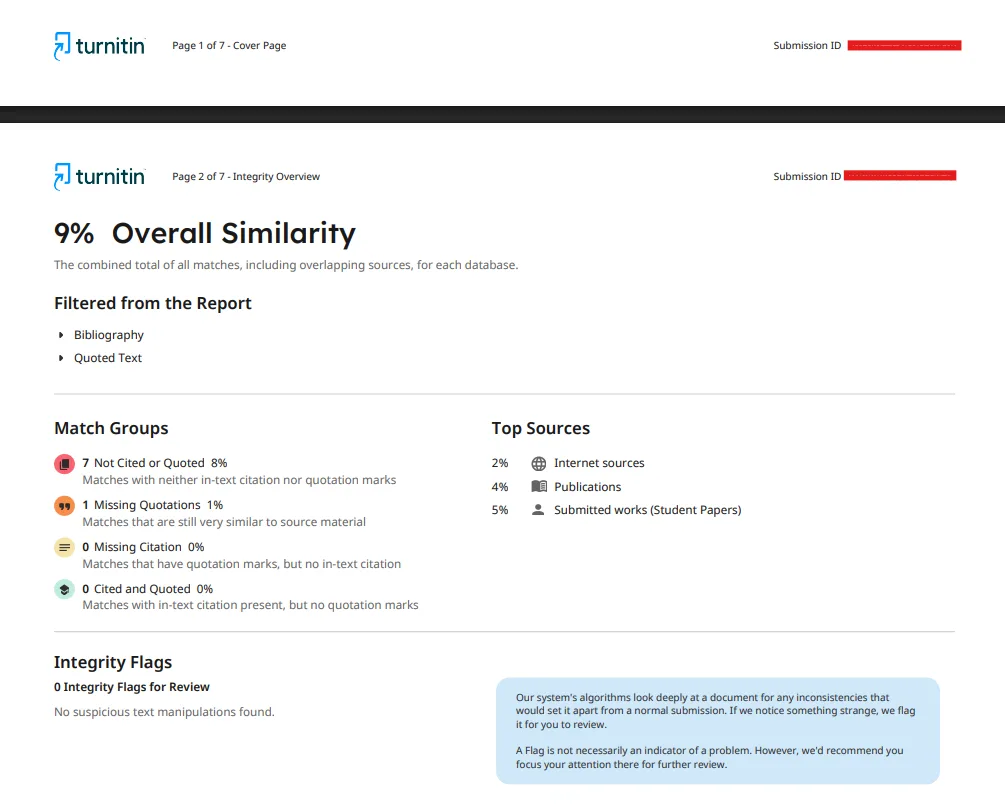
Image: Turnitin Similarity Check Score
For example, a paper with a similarity score of 9% contains text that Turnitin has identified as matching other sources. However, this does not necessarily mean that 9% of the paper is plagiarised.
Some matches may come from correctly cited quotations, standard terminology, commonly used expressions, or the bibliography. Other matches may indicate that a writer needs to improve paraphrasing or add appropriate citations.
The most useful approach is to examine the individual matches rather than relying exclusively on the overall percentage.
What Is a Good Turnitin Similarity Score?
There is no universal similarity score that guarantees a paper is free from plagiarism or will be accepted by an educational institution.
A relatively high score can sometimes be legitimate, particularly in documents containing extensive quotations, technical terminology, or reference lists. Conversely, a low score does not automatically establish that a paper is original.
Universities and colleges may have their own academic integrity policies and acceptable similarity thresholds. These requirements can also differ according to the type of assignment.
To improve your paper before submission:
Review the highlighted matching passages.
Ensure that borrowed ideas are properly cited.
Use quotation marks when reproducing source wording verbatim, where appropriate.
Paraphrase ideas genuinely in your own words while acknowledging the original source.
Review the reference list and check that citations follow the required referencing style.
Correct any accidental copying or insufficient attribution.
The objective should be academic integrity and appropriate source attribution, not simply achieving the lowest possible percentage.
Can Turnitin Detect AI-Generated Writing?
Turnitin offers AI writing detection through supported products and institutional subscriptions. When enabled and available for a submission, this feature estimates the proportion of qualifying text that its detection model considers likely to have been generated by AI writing tools.
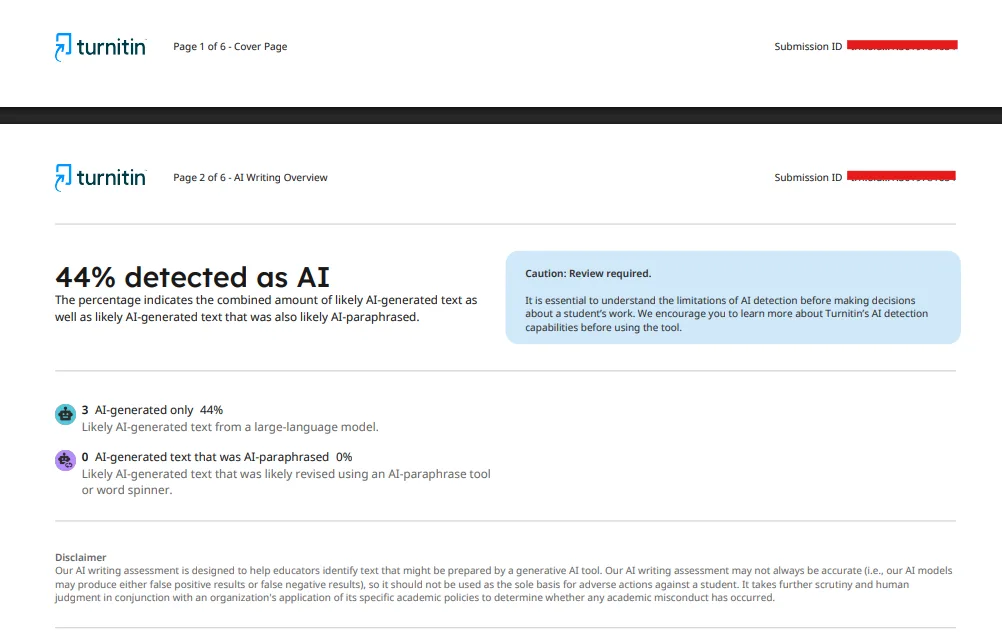
Image: Turnitin AI Check Score
The AI Writing Report is separate from the Similarity Report. Consequently, a document may have a low similarity score but still receive an AI writing indicator, or it may have a higher similarity score without being identified as likely AI-generated.
However, AI detection is not infallible. Turnitin acknowledges that its model can misidentify human-written or AI-generated text. An AI score should therefore not be treated as conclusive proof of academic misconduct.
Students should follow their institution's rules on AI use, including disclosure requirements where applicable. They should also ensure that submitted work reflects their own understanding and that all sources are properly acknowledged.
Turnitin AI Score vs Similarity Score
Although both results may appear within the same platform, they measure different things.
Similarity score: Indicates the proportion of submitted text that matches material in the comparison databases.
AI writing score: Estimates the proportion of qualifying text that the AI detection model considers likely to have been generated or modified using AI writing tools.
For instance, a document could have a similarity score of 12% and an AI writing indicator of 35%. These figures are not contradictory because the systems assess different characteristics of the text.
Neither score should be interpreted in isolation. The document's content, sources, writing process, and applicable academic policies all matter.
How Can You Check Your Paper Before Submission?
Reviewing your paper before submitting it can help you identify citation problems, investigate matching passages, and understand potential originality concerns.
A practical checking process involves the following steps:
Step 1: Prepare your document. Save your paper in a suitable format and ensure that the text, citations, and references are complete.
Step 2: Obtain a report. Use Turnitin through your institution or an appropriate document-checking service that clearly explains what checking tools and reports it provides.
Step 3: Review the similarity results. Examine highlighted passages and compare them with their identified sources.
Step 4: Review the AI writing results, if available. Treat any AI indicator as an estimate rather than definitive evidence about how the document was written.
Step 5: Make necessary revisions. Correct citation errors, improve paraphrasing, and ensure that your paper complies with your institution's academic integrity requirements.
Step 6: Check the revised document. If permitted and necessary, review the updated version to confirm that the changes have addressed the issues you identified.
Always confirm whether a checking service provides an actual Turnitin-generated report or uses a different detection system. Different tools may produce different results.
Where Can You Get a Turnitin Report?
Access to Turnitin is commonly provided through universities, colleges, and other educational institutions. Availability depends on the institution's licence and the services it has enabled.
If you need to review your document independently, you can explore document-checking options before submission.
At aiandplagiarismcheck.com, users can explore Turnitin document-checking services designed to help them review AI detection and text similarity results. Before purchasing, check the service description to confirm which reports are included, which tools are used, and what you will receive.
Remember that a similarity report and an AI detection report serve different purposes. Understanding both can help you make more informed revisions to your work.
Frequently Asked Questions
Does a 0% Turnitin similarity score mean my paper is plagiarism-free?
Not necessarily. A 0% score means that the system did not identify matching text under the settings and databases used for that check. It does not guarantee that every idea is original or that all sources have been acknowledged correctly.
Can Turnitin detect ChatGPT?
Turnitin provides AI writing detection for supported submissions when the relevant feature is enabled. However, detection is not guaranteed to identify every AI-generated passage correctly, and results should not be treated as definitive proof.
Is Turnitin's AI score the same as its similarity score?
No. The similarity score measures text matches against comparison sources, while the AI writing indicator estimates how much qualifying text may have been generated or modified using AI tools.
Can I reduce my similarity score by paraphrasing?
Genuine paraphrasing can reduce unnecessary textual overlap, but paraphrased ideas still require citations when they originate from another source. The aim should be accurate attribution and original expression rather than manipulating a score.
Can I check my paper without a university account?
Access depends on the available service. Many students use Turnitin through their educational institutions, while independent checking services may offer alternative options. Confirm the provider, report type, and terms before paying for a check.
Final Thoughts
Turnitin can be a useful tool for reviewing text similarity and, where enabled, identifying writing that may have been generated using AI. However, neither a similarity percentage nor an AI writing indicator provides a complete judgment of academic integrity.
The best way to prepare a paper is to review the underlying report, verify sources, cite ideas correctly, and follow your institution's rules. Understanding what the results mean is more valuable than focusing on a single percentage.
If you want to review your document before submission, visit aiandplagiarismcheck.com to explore the available document-checking options.
Related Article: Turnitin AI and Plagiarism Checker in United States (USA): Get Reports from TTN Check